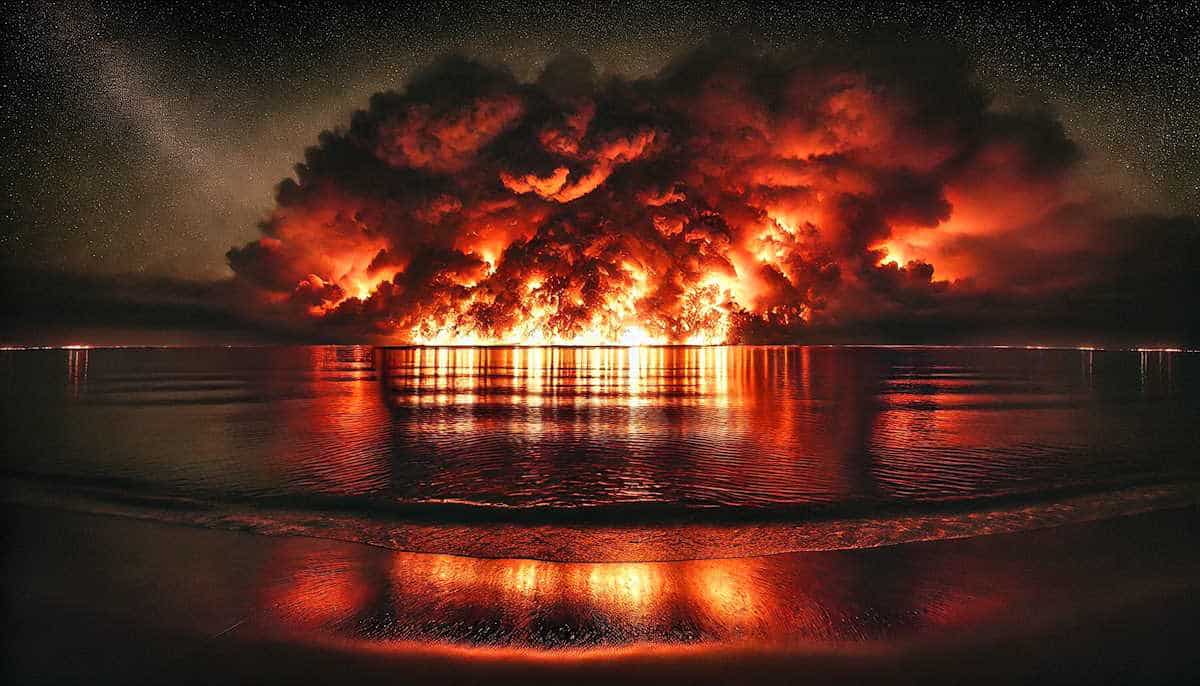
The Peshtigo Fire: What America's Deadliest Wildfire Still Teaches Wildland Firefighters
On the same night that the Great Chicago Fire lit up the headlines, a far deadlier fire was erasing a Wisconsin lumber town and sixteen communities around it.
Most people have never heard of it. But if you carry a Pulaski, run a brush truck, or brief a crew before a red flag day, the Peshtigo Fire is one of the most important fires you’ll ever study.
It is the deadliest wildfire in American history — and it is a textbook, written in ash, on how fuel, weather, and terrain come together to kill.
Our latest episode of The Last Alarm tells the full story. This article walks through what happened and, more importantly, what a modern wildland firefighter should take off the fireground because of it.
The night the Midwest burned
October 8, 1871. Northeastern Wisconsin. The lumber town of Peshtigo held roughly 1,700 people — millworkers and families who came for the timber.
For weeks the air had smelled of smoke, because small fires had been smoldering at the edge of the clearings for days. Nobody thought much of it. That was simply how the frontier was cleared.
By the next morning, most of the town was gone. An estimated 800 people died in Peshtigo alone, and somewhere between 1,200 and 2,400 across the whole burned region — more than a million acres in a single night.
The records burned with the town, so we will never know the exact number. What we do know is that a wall of fire reached Peshtigo after dark and the town had roughly one hour left.
That is not a fire spreading. That is a firestorm. And every element that built it is still on your size-up checklist today.
A textbook fire environment triangle
Wildland fire behavior is governed by three interacting factors: fuels, weather, and topography — the fire environment triangle that anchors S-190 and every fire behavior class since.
Peshtigo is what happens when all three line up against you at once.
Fuels. The summer of 1871 was a drought. The last soaking rain fell in early July, and for three months the forest baked.
Worse, the ground was buried in slash — the branches, tops, and debris left behind by logging — piled along the riverbanks and drying like kindling.
Railroad crews and farmers were clearing land the fast way: they cut, and they burned. The entire landscape had been turned into a continuous, cured, receptive fuel bed. In modern terms, the energy release component was off the chart and nobody was measuring it.
Weather. On October 8, a strong storm system moved across the plains and drove a cold front toward Wisconsin.
The winds came up hard out of the southwest. Those winds found the dozens of small land-clearing fires scattered across the region and did something monstrous with them — fanning them, merging them, driving them together into one mass of flame.
This is the part that should stop every firefighter cold: the fire didn’t wait for the weather. The weather delivered the fire.
Topography. The land around Peshtigo is not dramatic country, but it didn’t need to be.
Flat, fuel-choked terrain let the fire run unbroken for miles with nothing — no ridge, no rock, no green — to slow it. When the three legs of the triangle max out together, terrain doesn’t have to be steep to be deadly.
When a fire makes its own weather
Here is the fire science, plainly. When a fire grows large enough and hot enough, it stops depending on the ambient wind and starts generating its own.
The rising column of superheated air pulls fresh oxygen in from every direction, feeding the fire and accelerating it — until it becomes a self-sustaining firestorm. Temperatures in that kind of event can reach around 2,000 degrees, and the winds inside it can top 100 miles per hour.
At Peshtigo, survivors described a fire whirl — a genuine tornado of flame — that tore through the streets and threw rooftops and rail cars into the air.
That black wall over the treeline was not just smoke. It was superheated gas, fuel suspended in the air, waiting for oxygen to ignite it all at once.
Wildland firefighters have a word for the smaller, survivable version of this: a blowup. A fire building heat in a drainage or a fuel-loaded flat can go from a manageable few chains per hour to an 80-chain-per-hour run in minutes.
Peshtigo is the extreme end of that same physics. And the physics has not changed in 155 years.
Lesson 1: The triangle still runs the fireground
The single biggest takeaway from Peshtigo is that no one was reading the fire environment.
They saw drought, they saw slash piling up, they saw wind in the forecast, and they treated each as a nuisance instead of a warning.
Today we teach crews to read fuels, weather, and topography together, because it is the combination that produces extreme behavior.
Peshtigo is the proof of concept. When your fuels are cured, your relative humidity is on the floor, and a front is about to swing the wind, you are looking at the Peshtigo recipe on a smaller scale.
Lesson 2: Wind is the threat — respect the red flag
If you take one thing from this fire, make it wind. The Peshtigo firestorm was, at its heart, a wind event that found available fuel.
That is exactly what a Red Flag Warning is built to flag: the marriage of critically dry fuels with strong wind and low humidity.
In 1871 there was no warning system, no spot forecast, no incident meteorologist. Today there is — and those tools exist in large part because fires like Peshtigo, Hinckley, and Cloquet taught the country what a dry forest and a hard wind can do together.
When the IMET says a front is coming through with a wind shift, that is not background noise. That is the whole ballgame.
Lesson 3: LCES — the river was the safety zone
The people of Peshtigo who survived almost all did the same thing: they got to the river.
The Peshtigo River was their safety zone, and the streets down to it were their escape route. The ones who sheltered in buildings — the ones who had no escape route and no survivable safety zone — largely did not make it.
Strip the tragedy down and you are left with LCES: Lookouts, Communications, Escape Routes, and Safety Zones — Paul Gleason’s foundation for safe fireline work. Peshtigo had none of it.
No lookout watching the fire’s approach, no way to communicate the threat across town, no identified escape route, and no safety zone until people improvised one in the water.
Every time you scout your escape route and confirm your safety zone before you engage, you are doing the one thing the people of Peshtigo never had the chance to do.
Lesson 4: Learn to recognize a blowup before it happens
Extreme fire behavior gives warning signs — the same ones baked into the 18 Watch Out Situations and the 10 Standard Firefighting Orders.
Rapidly increasing wind. Spotting ahead of the main fire. A column that stands up tall and then leans. Erratic behavior as fuels, weather, and terrain align.
Peshtigo’s warning signs stretched over weeks — the drought, the smoke, the merging small fires — and nobody was positioned to read them.
The modern discipline is to base your actions on current and expected fire behavior, and to keep informed on conditions as they change.
That habit is the difference between repositioning early and getting caught.
Lesson 5: The wildland-urban interface was born here
Peshtigo was a town built in the middle of the fuel — homes and mills ringed by forest and slash, with no defensible space and no buffer. We have a name for that now: the wildland-urban interface, or WUI.
And we have watched its danger come roaring back in our own time — Paradise in 2018, Lahaina in 2023 — communities overrun in minutes by fire moving faster than anyone could flee.
The lesson Peshtigo offered in 1871 is the same one the WUI demands today: fuel management, defensible space, hardened structures, and evacuation planning are not optional where people live inside the fuel bed. They are the price of admission.
Why Peshtigo still matters
Here is the hard part of Peshtigo’s story. For a long time, almost nothing changed. The logging went on, the burning went on, and Wisconsin would face major fires again and again in the decades that followed. The lesson sat there in the ashes, and the country wasn’t ready to read it.
We are ready now — but only if we keep telling the story. The people of Peshtigo weren’t careless or weak. They lived by the rules of their time, in a landscape whose danger they did not yet understand.
They paid for that knowledge so that we would have it. Every firefighter who reads the wind before the flames arrive, who scouts an escape route, who respects a red flag day, is carrying their lesson forward.
Watch the full story
Our new episode of The Last Alarm tells the complete story of the Peshtigo Fire — the summer that set it up, the night it came, the communities that were lost, and the fire-behavior lessons still taught today.
Watch it here: https://youtu.be/14gS6_bJeKY — and if it moves you, share it with a firefighter who should know this history.
For more on firefighter careers, health, tactics, and fire history, explore the rest of Firefighter Connection — and find more on the mindset side of this job over at The Stoic Firefighter
Until the next alarm — learn the lessons. Pass them on.