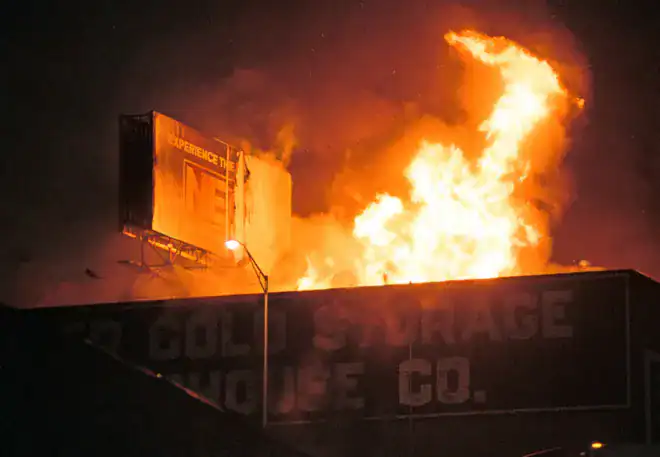
The Worcester Cold Storage Fire: The Night the Fire Service Learned When to Stop
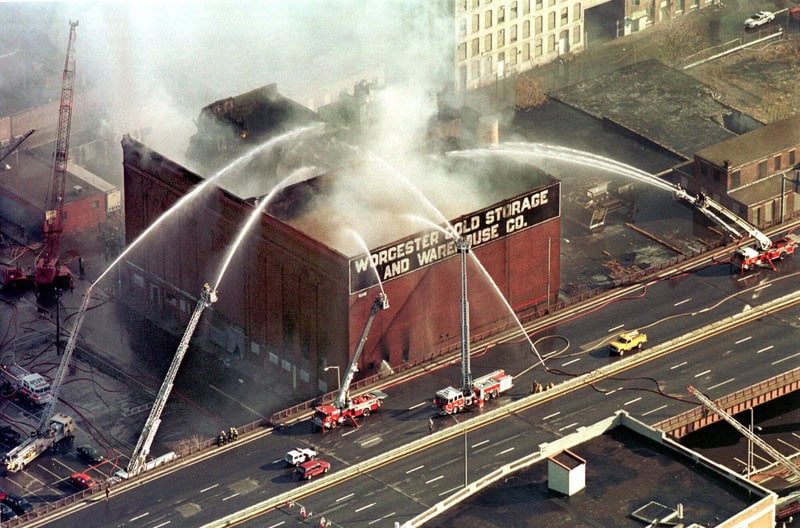
Every firefighter carries a few fires they never rode to. Fires that happened to someone else, in another city, maybe before they were born — but that live in the back of the rig anyway, in the way we train, the gear we carry, and the calls we make on the fireground.
For the American fire service, December 3, 1999 is one of those nights. Six firefighters walked into an abandoned warehouse in Worcester, Massachusetts to search for two people who had already made it out. None of the six came home.
This is the story of the Worcester Cold Storage and Warehouse fire — what the building took away, the challenges the crews faced inside it, the six men the job cost us that night, and the lessons that changed how every one of us operates today. If you have never studied this fire, study it. If you have, it is worth another look.
We tell this story minute by minute in our new documentary, “The Fire With No Windows.” Watch it here:
A building designed to beat you
266 Franklin Street was built in 1906 as a cold-storage warehouse — six stories of brick that once held meat for the city of Worcester. A building like that is built to do one thing: keep the cold in. So above the ground floor, there were no windows at all.
The walls were packed with insulation — asphalt-soaked cork, polystyrene, foam. The interior was a honeycomb of freezer rooms opening onto freezer rooms, identical hallways, dead ends.
By 1999 it had stood abandoned for years, with no sprinklers and no detectors of any kind.
Understand what that means to a firefighter. No windows means no way to vent the smoke, no glow to orient by, and no second way out if the first one closes behind you. Insulated walls mean the building holds its heat like a thermos, so the environment cooks instead of cooling. And a maze floor plan, in zero visibility, means every wrong turn looks exactly like the right one.
This was not a bad building to have a fire in. It was, in every way that matters to a company going interior, a building designed to beat you.
A fire no one saw coming
Two people had been living inside the vacant warehouse. Sometime in the late afternoon, a knocked-over candle started a fire on the second floor. They tried to put it out. They could not. So they left the building — and they told no one.
With no windows, no detectors, and no one inside to see it, the fire burned in secret. By the time an off-duty police officer driving past spotted smoke coming off the roof and called it in around 6:13 p.m., the fire had been growing for somewhere between thirty and ninety minutes.
The first alarm was struck at 6:15. That is a head start no fire department can give back. First-arriving crews went interior and began to knock it down — and then came the report that changed the whole night: two people might still be inside. So Worcester’s firefighters did what firefighters do. They went looking.
The search that became a rescue
Rescue 1 — Paul Brotherton and Jeremiah Lucey — worked the upper floors as conditions fell apart around them.
The thin haze the first crews had seen banked down into a thick, black cloud that swallowed a hand held in front of the face. No windows to let it out. No landmarks. No light. At 6:47 p.m., the emergency message came: they were lost, and they were running low on air.
Every firefighter on that fireground heard it, and crews went up after them.
In the same blinding maze, two more teams became disoriented on the upper floors — Lieutenant Thomas Spencer and Firefighter Timothy Jackson of Ladder 2, and Lieutenant James “Jay” Lyons and Firefighter Joseph McGuirk of Engine 3. More radio calls for help. More low-air warnings.
By the 7:24 head count, command had confirmed the number no one wanted to hear: six firefighters were missing inside the building.
Look hard at the challenges those crews were fighting, because none of them were about a lack of courage. They were committed deep into a massive structure on thirty-minute air bottles, crawling more than two hundred feet from a single interior stairway just to reach the search area.
There was no preplan on file for a building almost nobody had been inside in years. The radio traffic of a five-alarm fire overwhelmed the system.
Accountability strained under the weight of crews cycling in and out with fresh bottles for more than an hour and a half. And the building itself gave back nothing — not light, not sound, not direction.
That is the trap this fire set: brave, competent firefighters doing everything they were trained to do, in a structure that erased every tool they normally use to find their way back.
The order to stop
By 8:00 p.m., the building was turning on everyone still in it. Fire had vented through the roof and the structural integrity was failing. District Chief Mike McNamee made the call no chief ever wants to make. He ordered the building evacuated — and then he stood in the doorway and held it.
Firefighters wanted back in. Their brothers were up there. He told them no. Six were missing, and he would not make it eight. The operation shifted from an offensive interior attack to a defensive one, with heavy streams working the building from outside.
It is remembered as one of the hardest and most correct command decisions in the history of the American fire service — and notice which decision earned that place in history. Not the order to go in. The order to stop.
That is the part of this job we talk about least and need to understand most: sometimes the bravest thing on the fireground is the discipline to hold the line at the door.
The Worcester Six
The fire burned for days. The recovery took eight of them, and the last of the six was carried out on December 11th. Firefighters came from across the country, and beyond it, to stand for the funerals. The fire service knows these men as the Worcester Six:
Firefighter Paul Brotherton, Rescue 1
Firefighter Jeremiah Lucey, Rescue 1
Lieutenant Thomas Spencer, Ladder 2
Firefighter Timothy Jackson, Ladder 2
Lieutenant James “Jay” Lyons, Engine 3
Firefighter Joseph McGuirk, Engine 3
They were fathers, husbands, sons, and brothers. Several of them left children who would grow up to wear the same badge on the Worcester Fire Department.
They went into that warehouse for strangers — for two people they were told might still be trapped inside. That is the weight of this calling, and it is why we honor them by learning from the night they were lost.
A note on ranks. News coverage of this fire lists the men’s ranks inconsistently — Timothy Jackson, in particular, is frequently reported as a lieutenant. The ranks used here follow the National Fallen Firefighters Foundation’s official Roll of Honor (firehero.org), which records Thomas Spencer and James “Jay” Lyons as lieutenants and Paul Brotherton, Jeremiah Lucey, Timothy Jackson, and Joseph McGuirk as firefighters. Where accounts conflict, we defer to the NFFF memorial and the NIOSH report.
What the fire changed
The federal investigation that followed — NIOSH report F99-47 — read like a list of everything the building took away. No windows, so no ventilation, no orientation, and no secondary escape. An interior maze with no preplan on file. Crews committed deep on thirty-minute bottles.
A search launched for two occupants who had already walked out hours earlier. And the report was careful to make one thing clear: none of it was any one person’s failure. That was the point. The system itself — how the fire service sized up vacant buildings, tracked its crews, and found its lost — simply was not built for a building like this one. So the fire service rebuilt it.
Thermal imaging cameras. In 1999, a TIC was rare and expensive, and most companies did not carry one.
After Worcester, they spread through the American fire service until today a thermal imaging camera rides on virtually every first-due engine in the country, and lost-firefighter searches are run through it.
The camera does exactly what that windowless building denied those crews: it lets you see heat and shape when your eyes give you nothing.
Rapid intervention teams. Worcester drove home the need for crews staged for one job only — rescuing lost or trapped firefighters — in position and ready before the mayday, not scrambled together after it. RIT became standard doctrine, not an afterthought.
Mayday training and air management. Calling the mayday early, clearly, and without hesitation became something we drill until it is reflex. Air management turned into a discipline — knowing how deep you can commit on the air you carry, and turning around while you still have a margin, not after it is gone.
Vacant buildings and risk-versus-reward. The fire changed how the service treats abandoned structures: marking and placarding them, preplanning them, and weighing the risk against what can actually be saved.
Risk a lot to save a lot. Risk little to save little. Risk nothing for what is already lost. That last line is the hardest to live by on a real fireground, and Worcester is why we say it.
Accountability systems, the incident command structure, a dedicated safety officer, guide ropes and high-intensity lights at entry points — the NIOSH recommendations touched all of it. Piece by piece, the modern fireground you work today was shaped by what went wrong in that warehouse.
Carry it forward
The Worcester Six died searching for two people who were already gone. It is tempting to read that as a tragedy of wasted effort, but that is not how the fire service reads it.
You go looking because someone might be there. That willingness is the heart of the job — and the whole reason we owe it to each other to be smarter, better trained, and better equipped than we were on December 3, 1999.
The warehouse is gone now. On the lot where it stood, the city built the Franklin Street fire station, and the firefighters who work there today start every shift on the ground where the six were lost.
If your academy taught you to call the mayday early, manage your air, and trust the TIC in zero visibility, understand that those lessons did not come from a textbook.
They have six names on them. Learn them. Pass them on. And look out for each other.