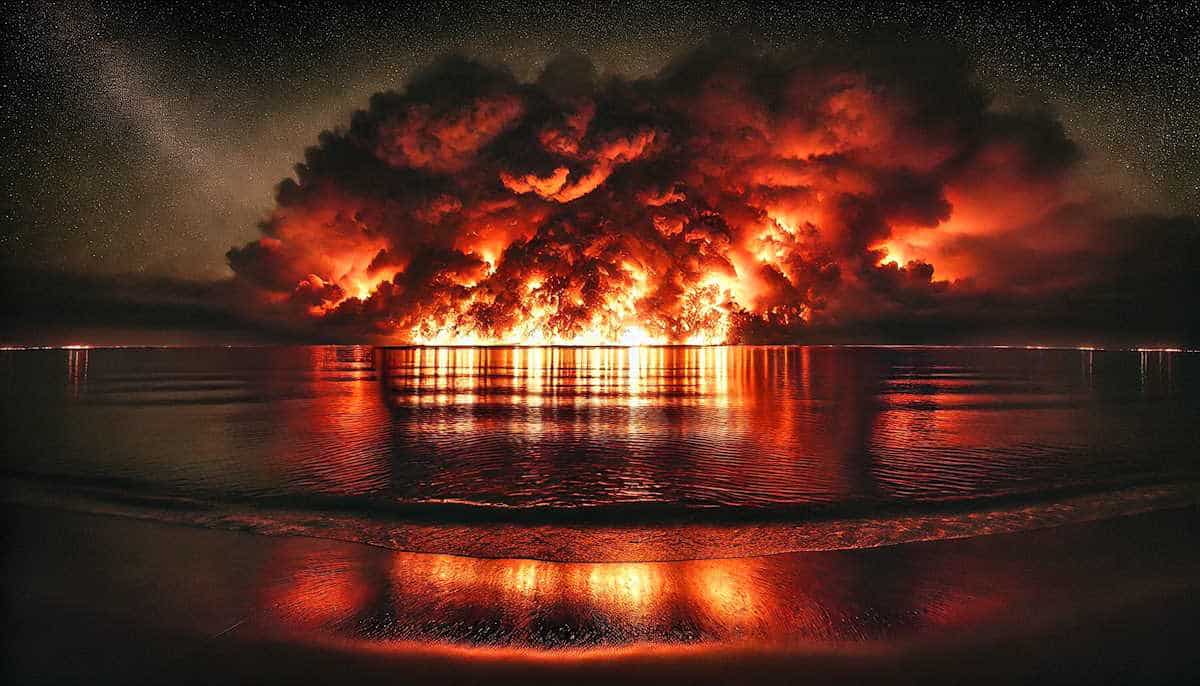
One hundred fifty-five years ago tonight, a lumber town of about 1,700 people in northeast Wisconsin went to bed with smoke in the air. Nobody thought much of it. The woods around Peshtigo had been smoldering for weeks, and by October of 1871 the smell of burning timber was as ordinary as the sound of the mill.
By morning, Peshtigo was gone. Only a couple of structures were left standing. Hundreds of townspeople were dead, and across a stretch of northeast Wisconsin and Michigan’s Upper Peninsula the fire killed somewhere between 1,200 and 2,400 people. Nobody will ever know the real number. Entire families disappeared with no one left to report them missing. The fire burned roughly 1.2 to 1.5 million acres and wiped out more than a dozen communities in a single night.
It remains the deadliest wildfire in American history. Most people have never heard of it, because it happened on the same night as the Great Chicago Fire, and Chicago got the headlines.
I spent 32 years in the fire service. I worked wildland, ARFF and USAR, and I spent a lot of years in front of recruits at the academy and the community college. I’ve read Father Peter Pernin’s eyewitness account of Peshtigo more times than I can count, and I pick up something new every time. What happened that night is history, but the mistakes that set it up are ones I watched people make over and over in my own career. So on this anniversary, I want to walk through what happened and what it still has to teach the people who answer the call.
A Town Built on Fuel
Peshtigo was a company town. Its center was a woodenware factory, the largest in the country at the time, turning out pails, tubs and broom handles. The houses were wood. The sidewalks were planks. Sawdust and wood scraps piled up wherever the mill and the lumber yards did their work.
Out in the woods it was worse. Loggers took the good timber and left the tops and branches behind in slash piles. Some of those piles covered acres and stood taller than a man. Railroad crews cutting right-of-way through the forest cleared the brush by burning it. Farmers clearing new ground did the same. Setting fire to the woods was simply how land got cleared in 1871, and nobody gave it much thought.
Then the rain quit. 1870 had been dry. 1871 was drier. By late summer the swamps had dried out and the forest floor had turned into kindling. Small fires burned for weeks across the region. Some days the smoke was thick enough that ships on Green Bay sounded their horns to navigate. People fought spot fires when they got close to homes and went back to work when they laid down.
That last part is the one I want you to remember. The people of Peshtigo had lived with fire so long that it stopped looking like a threat.
The Night of October 8
On October 8, an eastward-moving cold front pushed into the region. The wind picked up hard. All those scattered fires that had been creeping through the woods for weeks got the oxygen and the push they needed, and they merged.
Father Pernin described an eerie stillness over the town that evening, then a distant roar coming through the dark. Survivors compared the sound to a freight train. What hit Peshtigo was a firestorm. The heat drove a convection column so violent it produced fire whirls strong enough to throw rail cars and houses through the air. Witnesses described it as a tornado of fire. According to the Wisconsin Historical Society, the fire burned a swath of forest ten miles wide and forty miles long in about two hours.
The town had a fire engine, a heavy iron one. Afterward it was found melted. No apparatus, no crew and no amount of water was going to stop what came into Peshtigo that night.
People ran. The ones who made it to the Peshtigo River had the best chance. They stood in the water for hours, ducking under when the heat got unbearable, throwing water on each other’s heads and clothes, while burning debris blew across the surface and the town burned on both banks. Cattle and horses crowded into the river beside them. Some people drowned. Others died of cold after hours in the water. Pernin himself spent the night in the river after pushing the tabernacle from his church into the water.
The people who sheltered in buildings, or tried to outrun the fire in the open, mostly didn’t make it. Searchers later found the bodies of people with no burns at all, killed by heat and bad air. Others were burned so completely there was nothing left to identify. In the Peshtigo Fire Cemetery today, about 350 unidentified men, women and children lie in a mass grave.
When it was over, the telegraph lines were down. Peshtigo was cut off. By the time word reached the outside world, the country’s attention had locked onto Chicago. Wisconsin’s governor was actually in Chicago helping with that relief effort, and it fell to his wife, Frances Fairchild, to redirect a relief train loaded with supplies north to Green Bay. Help came, but it came slowly to people who had lost everything.
The Lessons That Still Apply
I’ve been to enough fires to know that hindsight makes everybody look smart. The people of Peshtigo didn’t have fire weather forecasts, red flag warnings, the Ten Standard Firefighting Orders or anything we’d recognize as wildland fire science. They did the best they could with what they knew. But what they knew didn’t match the hazard they were living with, and that gap is exactly where firefighters still get hurt and killed.
Normal is the most dangerous word in the fire service
Peshtigo’s residents had watched smoke on the horizon for weeks. Every day nothing happened made the next day feel safer. Safety people call this normalization of deviance. Firefighters just call it complacency.
I’ve seen it on fireground after fireground. The crew that’s run a hundred bread-and-butter room-and-contents fires stops sizing up the 101st. The engine company that always lays the same supply line from the same hydrant stops checking if that hydrant still works. The wildland crew that’s worked a fire for six days stops looking up at the ridge. The conditions haven’t gotten safer. The people have just stopped seeing them.
If you catch yourself thinking “we always do it this way” or “it’s never been a problem,” treat that as a warning sign. Peshtigo had never had a problem either.
Fuel is the one thing you can actually control
You can’t control the weather and you can’t control topography. Fuel is the only side of the fire triangle a community gets to manage before the fire shows up. In 1871 that meant slash piles, sawdust and a town built entirely of wood sitting in the middle of a forest.
Today we call it the wildland-urban interface, and it keeps growing. Defensible space, Firewise programs, fuel reduction projects and code enforcement aren’t glamorous work. Nobody gives out medals for a brush clearance inspection. But every acre of fuel treated and every home with a clean 30-foot perimeter is one less Peshtigo waiting to happen. If your department does community risk reduction, that work belongs in the same category as your hose drills.
Weather turns a fire you can fight into one you can’t
The fires around Peshtigo had been manageable for weeks. A single frontal passage changed everything in a matter of hours. That pattern shows up again and again in the history of fatal wildland fires: a wind shift, a frontal passage or an afternoon blowup that catches crews out of position.
That’s why “keep informed on fire weather conditions and forecasts” sits near the top of the Standard Orders. Get the spot weather forecast. Know when the front is due. Post a lookout who’s actually watching. If the forecast calls for a wind shift at 1500, you’d better know where your crew is going to be at 1430.
Know your safety zone before you need it
The Peshtigo River saved hundreds of lives. People who reached it had a place where the fire couldn’t get to them. People who hid in buildings or tried to run in the open often died. Those who lived didn’t plan the river as a refuge. They found it in the dark, in a panic, with fire on their heels.
That’s the whole reason we teach LCES: lookouts, communications, escape routes and safety zones. You identify them before you engage, and you re-evaluate them every time conditions change. A safety zone you can’t reach in time doesn’t count, and an escape route that runs uphill through unburned fuel isn’t an escape route.
The same lesson applies to the public. The 2018 Camp Fire in Paradise, California, showed what happens when a whole town tries to evacuate down a handful of roads at once. Pre-planned evacuation routes, Ready-Set-Go programs and public warning systems are how we keep civilians from having to find their own river in the dark.
When communications fail, everything slows down
Peshtigo went silent the moment the telegraph lines burned. Nobody outside knew how bad it was, and relief arrived late. On a fireground, the same thing happens on a smaller scale every time a radio fails, a channel gets overloaded or a crew moves without telling anybody.
Test your radios. Know your backup channels. Know how to reach mutual aid when your primary system is down. And when you’re running the incident, remember that the worst problems are often the ones nobody has reported yet.
Plan for the fire that’s never happened
The people of Peshtigo had no frame of reference for a firestorm. Nothing in their experience told them a forest fire could burn forty miles in two hours or melt an iron fire engine. Their plans, such as they were, were built for the fires they had seen.
Fire departments do the same thing when we plan for the average call instead of the worst one. Pre-incident plans, large-scale drills and honest conversations about what your community would do if the worst day showed up are what separate a department that’s ready from one that’s lucky. Ask what your Peshtigo looks like. Maybe it’s a grass fire on a windy day pushing into a subdivision with one way out. Maybe it’s an apartment complex with a known sprinkler impairment. Whatever it is, plan for it before it finds you.
Remembering Peshtigo
There’s a reason I keep coming back to this fire. Every fire code, every tactic and every drill we have was paid for by somebody, and the people of Peshtigo paid a terrible price for lessons the rest of the country barely noticed. They deserve better than to be a footnote to Chicago.
Tonight, take a minute to remember the people of Peshtigo and the surrounding settlements, and especially the 350 who still have no names. Then take the lessons back to your crew. Talk about complacency at the kitchen table. Walk your district and look at it the way a fire would. Check your weather. Know your way out.
I put together a full documentary on the Peshtigo Fire for my YouTube channel, The Last Alarm. It covers the conditions that set up the fire, what happened that night and what it means for firefighters today. You can watch it here:
Watch: The Peshtigo Fire on The Last Alarm
If it’s worth your time, share it with your crew. History only teaches the people who bother to learn it.
Stay safe out there.
Roger Waters, Retired Fire Chief