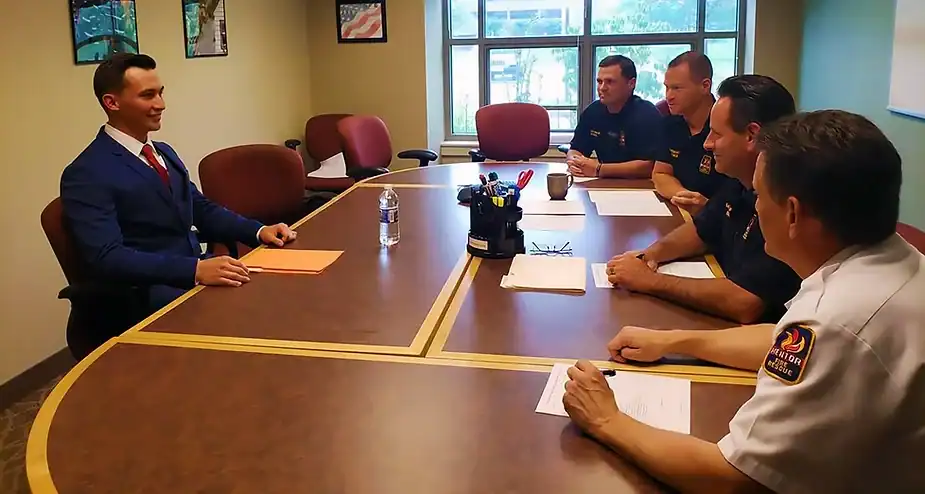
I sat on a lot of oral boards. Some were entry-level hiring boards and some were promotional boards, at Greeley and later at Cloquet. Before that I was the nervous kid on the other side of the table, and it took me three tries to get hired at Greeley.
That gives me an unusual view of the oral board. I know how it feels in the chair, and I know what the raters are writing down while you talk. The two don’t line up as often as candidates think.
If you’re testing this spring, the next few months are your prep window. Here are the six mistakes I watched cost good candidates the most points, and what to do about each one.
1. Answers that sound memorized
I remember one candidate whose resume was as good as anything we saw that year. He had real experience, plenty of it outside the fire service, and he clearly knew the testing process. He’d done his homework on how to prepare.
Then he started answering questions, and every answer sounded like it came off a page. He’d read every list of oral board questions out there and built an answer for each one. Maybe every word was true. It came out rehearsed and stiff, and nothing we asked could get past it. We kept trying to find the real person in that chair and never did.
Raters score more than your content. We’re deciding whether we believe you, because we’re deciding whether we’d trust you on a crew. When an answer sounds recited, the panel stops hearing what you say and starts wondering who you actually are.
The fix: Prepare your stories and your points. Don’t memorize your words. A slightly rough answer that’s clearly yours will outscore a polished one that sounds borrowed.
2. The dictionary answer on integrity
Almost every board asks an integrity question, and I can tell you what most candidates will say, because I heard it over and over: “Integrity is doing the right thing even when no one’s watching.”
That answer is correct. Every candidate before you also gave it, so it tells the panel nothing about you. It used to drive me crazy.
We don’t want the definition. We want something you did. Maybe a cashier gave you too much change, or something got missed at the register, and you went back in and paid. Maybe you had a chance to cheat on a test and didn’t take it. Maybe you could have called in a favor to help your chances and chose not to.
The fix: Have one true, small story ready. Small is fine. Small is believable.
3. “I can’t think of a time”
“Describe a time when you saw a coworker steal.” “Describe a time you disagreed with your boss.” These behavioral questions sink more candidates than anything else on the board, and the worst answer is “I can’t think of a time.” Everybody has a time. You just didn’t think about it before you walked in.
Having a story isn’t enough, though, because these are moral questions. I sat on a board where a candidate was asked about seeing someone steal. He told us a friend had taken money from their employer, and he paid it back out of his own pocket.
I’m sure he thought that made him look loyal. But it didn’t fix anything. The employer never found out, and the friend never had to face it. He was covering for somebody.
A strong answer sounds like this: “I’d go to my friend first. I’d tell him I know what he did, and that I expect him to go to our employer and make it right. If he won’t, I’d take it to my supervisor.” That gives the friend a chance to do the right thing and doesn’t let the problem stay buried. A panel wants to see loyalty and integrity in the same answer.
The fix: Go back through the hard stretches of your life: a job you lost, a boss you clashed with, a time you had to tell someone no. Know how each one turned out and what you’d do the same or differently.
4. A resume that doesn’t add up
The panel reads your resume before you walk in, and we build questions from it.
One candidate’s resume listed wildland firefighting, volunteer firefighting, a fire science degree and a stack of fire service classes. So we asked the normal questions. When did you start on the wildland crew? When were you in school? Somebody on the panel did the math while he answered. For all of it to add up, he would have had to start in the fire service at about 12 years old.
He didn’t have an explanation ready, and from then on every answer he gave carried a question mark.
The fix: Keep every date on your resume accurate and know it cold. A gap is fine. Plenty of good firefighters have been out of work for a stretch. Expect the question and give a straight answer. And if there’s something in your past like a DUI or a charge, plan on it coming up, because the background check will find it anyway. A board can work with the truth. Nobody can work with a surprise.
5. Knowing nothing about the department
At Cloquet, Minnesota, the name is pronounced “Kloh-KAY.” One candidate said “Kloh-KET” all the way through his interview, for both the community and the department.
That’s a sore spot for a panel, because the people on it are proud of where they live and work. It also told us he’d never called the department, never visited a station and never talked to one of our firefighters. He knew nothing about us.
For the departments you really want, learn everything. Are they career or combination? Do they run their own ambulances? What special teams do they have? Greeley covered an airport, so aircraft rescue was part of the job. Find out why they’re hiring, too. A department building new stations needs different things than one replacing a wave of retirements. When you get to the chief’s board, those officers have gaps to fill. If you know they run a hazmat team and you did hazmat or safety work in a civilian job, tell them.
The fix: Call the department, visit a station and talk to the firefighters. Start with how to say the name.
6. “No, I think I’m good”
The last question on almost every board is some version of “Is there anything else you’d like to add?” I’d guess eight out of ten candidates answer, “No, I think I’m good.” That’s the panel’s last impression of you, and it says you didn’t prepare.
The panel is handing you the floor. Thank them for the chance to apply and, you hope, to join their department. Then remind them of the strengths that match what your homework told you they need. If you live in the community and want to serve it, and that’s true, say so.
The fix: Write a 30-second close before your board and practice it out loud until it sounds like you talking.
What to do between now and your next board
Start a notebook. After every oral board I sat as a candidate, I went out to my car and wrote down every question they asked and every answer I gave, as close as I could remember, plus what I’d do differently. My early boards were bad. I rambled, and the panels could see how nervous I was. That notebook is why my scores climbed.
Then get someone to run a mock board with you. Use real questions, have them sit across a table, and have them score you. I built a one-page scorecard for exactly that, based on the kinds of things I scored as a rater at Greeley and Cloquet. It’s free:
For practice questions, start with the 20 firefighter interview questions you need to prepare for and what the three levels of oral boards look like.
If you want all of it in one place, I wrote a book: The Oral Board, From the Rater’s Side of the Table. It walks through each stage of the board, how answers get scored, the hard questions about your past, and the chief’s interview, with more stories like the ones above. See what’s inside.
Good luck out there. Keep coming back. It worked for me.
Roger Waters spent 31 years in the fire service, from firefighter to acting fire chief, and ran hiring and promotional processes at two departments. More about Roger.