Why Training Is Everything: What It Actually Takes to Become a Firefighter
Every year, thousands of people decide they want to become firefighters. A fraction of them actually get hired. The difference isn’t heart — it’s preparation. This article breaks down what the training process really looks like, what departments are testing for, and what it takes to go from candidate to career firefighter. If you’re serious about this job, what you read here could be the difference between making the cut and going home empty-handed.
You’ve probably thought about becoming a firefighter. Maybe you’ve been thinking about it for years. You’ve watched the trucks roll out, done some research, maybe even started working out to get your body ready.
But here’s the part most candidates don’t fully grasp until it’s too late: the physical preparation is only half the battle. The other half — arguably the harder half — is the mental, technical, and procedural preparation that separates candidates who make it through training from those who don’t.
I want to walk you through what the training actually looks like. Not the glamorized version. The real version.
The First Thing They Put You Through Will Humble You
Before you ever see a flame, you’re going to put on the gear and do basic tasks. Climb stairs. Move through confined spaces. Drag equipment.
Simple stuff, right?
Wrong.
The moment you seal that SCBA mask to your face and start breathing compressed air, something happens. The world closes in. It feels claustrophobic. Your brain starts telling you that you’re running out of oxygen — even though you’re not. The average firefighter’s low-air alarm trips around the 12-minute mark. You’re out of air entirely in about 20.
That 20-minute window is what you’ve got. Everything you do inside a structure — finding a victim, fighting fire, surviving a Mayday — happens inside that window. And the faster your heart rate goes, the faster you burn through it.
This is why training isn’t just about getting in shape. It’s about learning to control your breathing under conditions that make every instinct in your body tell you to panic.
The Skills Course: 7 Events, One Bottle of Air, 15 Minutes
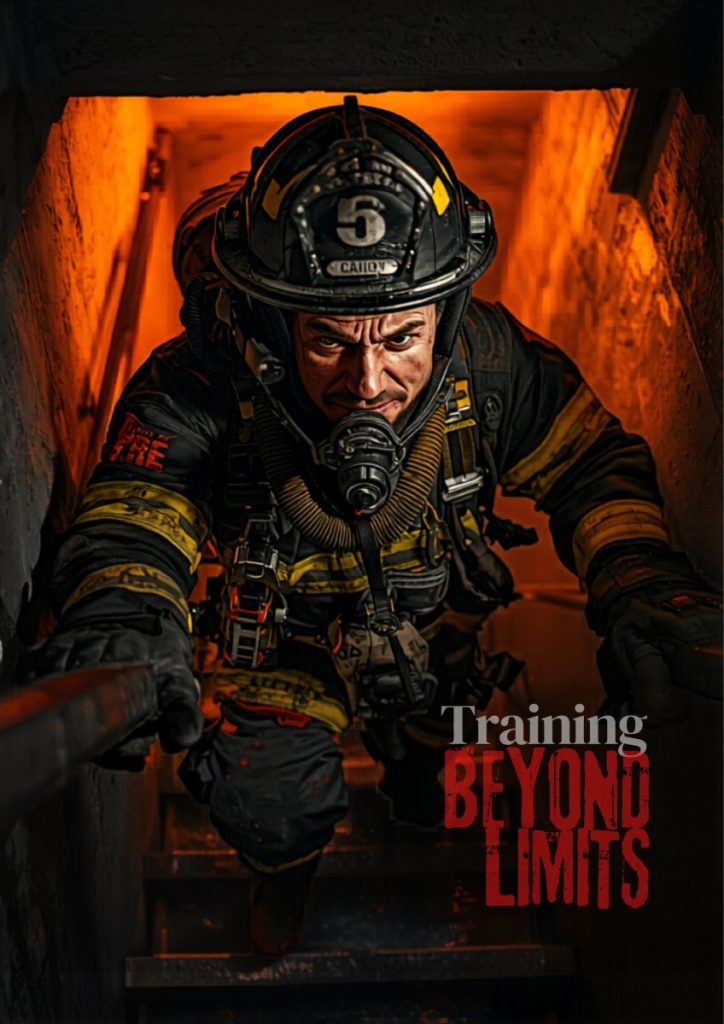
At the fire training academy, recruits are put through a skills course that condenses the essential functions of firefighting into a single timed evolution. Seven functional events. Fifteen minutes. One bottle of air.
The events aren’t complicated on paper:
- Climb stairs with high-rise packs to the fifth floor
- Perform vertical ventilation
- Pull ceiling to check for fire extension
- Conduct manual vehicle extrication
- Raise and work from a ground ladder
- Manage a charged hose line from multiple positions
- Search for and remove a victim
You practice each one individually. You study them. You get coached on technique. And then you do all seven back-to-back with smoke, heat, and a finite air supply working against you.
Here’s what nobody tells you: the test isn’t really about the seven events. It’s about air management. It’s about whether you can control your heart rate when you’re exhausted and overheated and the low-air alarm on your SCBA starts chirping. Because once that air is gone, you cannot work. That’s not dramatic language — that’s the physics of the situation.
Candidates who breeze through each individual skill but haven’t trained their bodies and minds to work efficiently under stress will fail this course. Not because they don’t know how to do the tasks. Because they burn through their air doing them.
This is why preparation matters long before you show up to the academy.
"When I Get That Call, I Fall Back on My Training"
One of the academy Instructors said something during the training evolution that every candidate needs to hear:
“When I get that call, I don’t know what my assignment is. I fall back on my training. I’m very confident in my equipment. I know what my role is. I know what the expectation is.”
Read that again.
He doesn’t think about what to do when the tone drops. He doesn’t try to remember. He falls back on training that’s been drilled until it’s automatic.
That’s the standard. And it takes time to build.
This is why you can’t cram for the fire academy the way you might cram for a written exam. The physical skills need to be in your body. The procedural knowledge needs to be in your muscle memory. You have to have done the reps — on the hose, on the ladder, in the gear — enough times that when your brain goes into survival mode, your hands still know what to do.
Three Things That Make a Firefighter
During the training, one of the senior instructors laid it out plainly. To make a good firefighter, you need three things:
Humility. You’re one person on a big team. Your job matters, but the department and the community are bigger than you. Candidates who walk into the process thinking they already have it figured out are the most dangerous ones in the building.
Work ethic. Show up and work hard when people are watching. Show up and work hard when nobody’s watching. Do it for 24 hours straight. Do it on your 30th call of the shift. The job doesn’t care how tired you are — and neither will the victim waiting for you to reach them.
Integrity. People hand you their baby because their baby isn’t breathing. They let you into their house at 3 a.m. during the worst moment of their life. They trust you completely and unconditionally. That trust has to be earned and never broken.
None of these are skills you develop the week before your oral board. They’re character traits — and the hiring process is specifically designed to evaluate them.
The Written Exam and Oral Board Are Part of the Training Pipeline
Here’s where a lot of candidates disconnect they treat the testing process as separate from the job itself. Pass the written exam, get through the oral board, survive the CPAT — and then the real stuff starts.
That’s backward.
The written exam tests whether you can learn and retain procedural, spatial, and mechanical information quickly and accurately. That’s exactly what you’ll be asked to do in every training evolution, every shift briefing, every emergency scene. Departments aren’t testing your knowledge of firefighter aptitude for fun. They’re screening for the cognitive baseline required to do the job safely.
The oral board evaluates judgment, communication under pressure, and whether you can articulate your reasoning clearly when someone’s asking hard questions. Sound familiar? It should — because that’s what you’ll be doing every time you give a size-up over the radio with smoke banking down around your head.
Preparing for these tests is training. It’s the first phase of it.
What "Ready" Actually Looks Like
The final evolution at the academy involved real fire, real smoke, and a victim inside the structure. The candidate who went through the training was clear about something afterward: even having compressed six months of content into two intense days, he wasn’t fully sure he’d remember everything.
And that’s the point.
You will never feel 100% ready. The job is too complex, the variables are too unpredictable, and the stakes are too high for anyone to feel fully prepared walking into a burning building for the first time.
What training does — real, sustained, repeated training — is bring you close enough to ready that the gap can be bridged by teamwork, by instinct, by the people next to you who’ve done this a thousand times.
But you have to do the work first. You have to know the material. You have to have the physical conditioning. You have to understand the tools, the procedures, the communication protocols — because when the cognitive load of a real emergency hits, there’s no bandwidth left to figure out basics.
If You're Serious About This Career, Start Now
The candidates who succeed in the hiring process aren’t the ones who started preparing two months before the test. They’re the ones who treated every day before the test as part of the training.
Start with the written exam prep — not to pass a test, but to understand the foundational knowledge the job requires. Work on the physical agility components not just to meet the standard, but to build the conditioning that will carry you through training and beyond. Think about who you are and what kind of firefighter you want to be, because the oral board will ask — and your answer needs to be real.
The fire service doesn’t need more people who want to wear the gear. It needs people who are willing to put in the work to earn it.
That starts today.
Looking for a structured breakdown of the firefighter testing process — written exam, oral board, CPAT, and everything in between? Firefighter Connection has you covered. Start at firefighterconnection.com.